

Keywords
civic culture
values
sovereignty
globalization
constitutional reform
How to Cite
Abstract
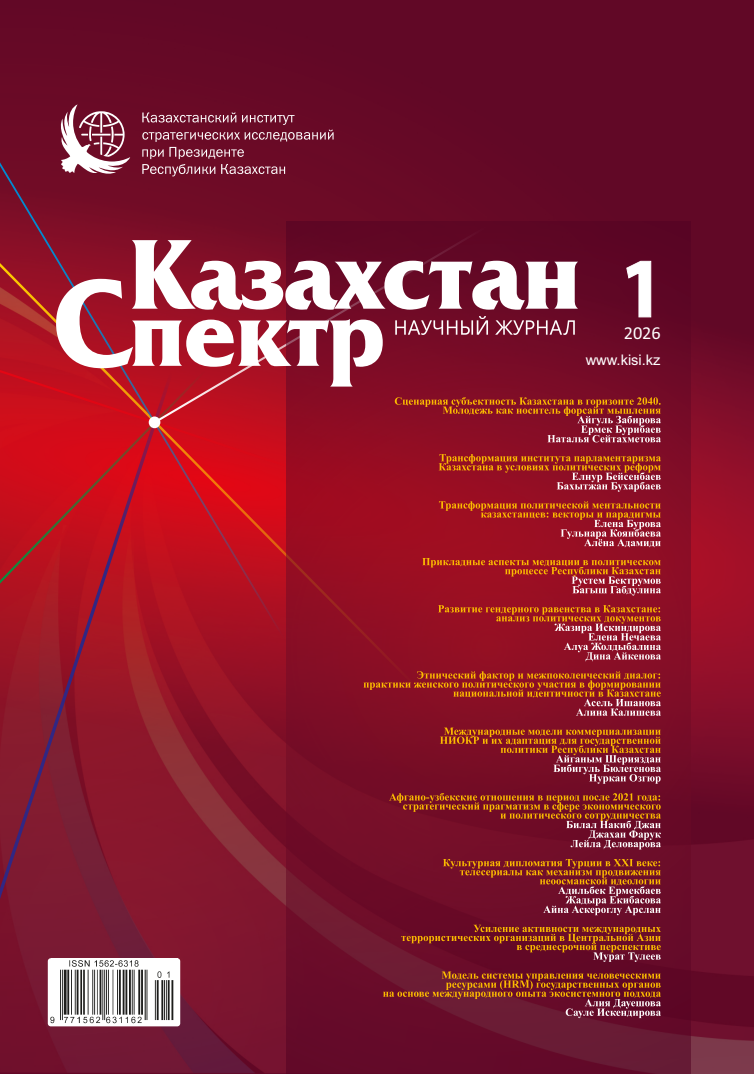
During the period of sovereign development, Kazakhstan has been undergoing an intensive process of transformation of political mentality, encompassing both consciousness and behavior. This process is driven by socio-economic and cultural factors, a targeted state policy aimed at the modernization of public consciousness, and broader global conditions. The article presents selected findings from a Kazakhstani study on value transformations in civic consciousness.
The research methodology, which combines a mass survey, expert assessments, and model-based reconstruction, was developed to evaluate the outcomes achieved through the implementation of state programs for modernization. A multi-dimensional analysis focuses on identifying changes in political mentality and on how these changes are perceived by Kazakhstani citizens. Particular attention is paid to the formation of a matrix of civic values and to the perception of key state ideological concepts. The effectiveness of initiatives aimed at modernizing public consciousness, assessed in terms of the consolidation of value concepts in both mentality and social practice, correlates with the objectives of constitutional reform.

This work is licensed under a Creative Commons Attribution 4.0 International License.
Copyright (c) 2026 Kazakhstan-Spectrum